
The vast diversity of art, thought and literature that flourishes across India has long served as a wellspring for creative expression. Few compositions capture this spirit of reverence for the countless contributors to spiritual and cultural life as eloquently as Tyagaraja’s Sri raga Pancharatna kriti “Endaro Mahanubhavulu.” In the composition, the saint-composer offers his obeisance to the many great souls who have attained elevated spiritual experience, declaring “Andhariki Vandhanamu” — salutations to all. This timeless sentiment has now found powerful visual form in a Natya Nadakam of the same name, conceived and scripted by scholar Dushyanth Sridhar and brought to the stage through the choreography of Anita Guha.
A Tribute Rooted in Tyagaraja’s Vision
Tyagaraja’s kriti is more than a musical masterpiece; it is a philosophical acknowledgment of the multiplicity of paths and personalities that have enriched the spiritual landscape of the subcontinent. The production takes this idea as its guiding principle. Rather than presenting a linear biography of the composer, it weaves together episodes from the lives of fourteen bhaktas drawn from different regions, linguistic traditions and historical periods. Each figure faced distinct challenges — social, personal or spiritual — yet remained anchored in devotion. By stringing these narratives into the framework of the kriti, the production transforms abstract reverence into a living, breathing theatrical experience.
Dushyanth Sridhar, known for his discourses, authorship and previous dance collaborations, has shaped the concept, story and narration. His approach emphasises the universality of the bhakti impulse while remaining attentive to the specific cultural textures of each saint’s milieu. The result is a work that feels both rooted in tradition and expansive in its geographical and chronological scope.
Choreographic Vision and Multidisciplinary Palette
The translation of this ambitious script into movement was entrusted to Anita Guha and her ensemble, Bharathanjali. The choreography is primarily rooted in Bharatanatyam, yet it deliberately incorporates elements from other classical and folk traditions to reflect the diversity of the bhaktas themselves. Moments of Kuchipudi, Odissi, Mohiniyattam and Ghoomar appear organically, allowing the dance vocabulary to shift with the cultural context of each story. This interweaving of styles avoids pastiche; instead, it underscores the production’s central thesis that greatness of spirit transcends regional boundaries.
Viewers and reviewers have noted the visual richness of the staging. Elaborate costumes, carefully designed jewellery and thoughtful use of props support the narrative without overwhelming it. Lighting and LED design contribute to the atmospheric transitions between episodes, while the ensemble’s disciplined execution ensures that the large-scale sequences retain clarity and emotional focus. The production has been described as a feast for the eyes, sustaining engagement across its substantial duration through a combination of group choreography, solo moments and dramatic tableau.
Music, Sound and Theatrical Atmosphere
Music plays an indispensable role in anchoring the production to its source. Composed by Dr. Rajkumar Bharathi, the score draws upon the spirit of Tyagaraja’s original while expanding into a broader soundscape suitable for dance theatre. The collaboration between Bharathi and sound designer Sai Shravanam — a pairing that has contributed to several earlier projects — provides both melodic integrity and contemporary sonic depth. The music supports the emotional arc of each bhakta’s story while continually returning to the gravitational pull of the title kriti.
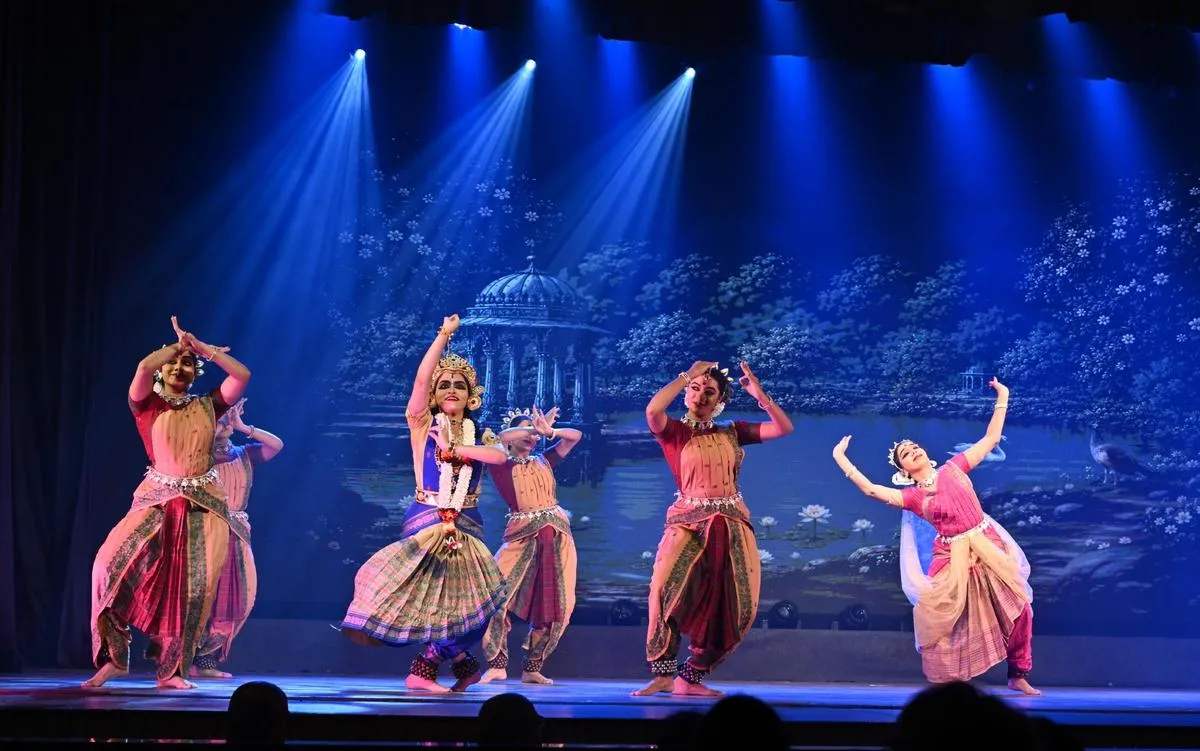
Narration by Sridhar bridges the episodes, offering context and reflection without interrupting the flow of movement. The overall effect is that of a modern Natya Nadakam that respects classical grammar while embracing the resources of contemporary stagecraft.
Reception and Cultural Resonance
The production received strong audience response during its initial presentations in Bengaluru and Chennai, with houseful houses and a cumulative attendance exceeding four thousand. Viewers have spoken of being transported by sequences that evoke specific sacred geographies and of experiencing the collective power of the final celebratory passages. The work’s ability to hold attention across a full evening speaks to the careful balance of spectacle, devotion and storytelling.
Upcoming presentations in Mumbai and Delhi indicate growing interest beyond the traditional centres of Carnatic music and Bharatanatyam. For many in the audience, the production offers a rare opportunity to encounter the lives of lesser-known or regionally specific saints alongside more familiar figures, all unified under Tyagaraja’s expansive vision of spiritual greatness.
Broader Significance
In an era when classical arts sometimes struggle to attract new audiences, “Endaro Mahanubhavulu” demonstrates the continuing vitality of collaborative, large-scale work rooted in the bhakti tradition. It shows that a single kriti can serve as the architectural foundation for an evening-length exploration of India’s spiritual plurality. By honouring both the specificity of individual lives and the universal impulse of devotion, the production extends Tyagaraja’s own act of homage into the present.
The collaboration between a scholar-narrator, an experienced choreographer and a skilled musical team has produced a work that is at once educational, aesthetically rich and emotionally resonant. It reminds viewers that the “many great souls” celebrated in the kriti are not confined to the past; their examples continue to inspire new forms of artistic expression. As the production travels further, it carries with it an invitation to recognise and revere the diverse expressions of spiritual seeking that have shaped the cultural fabric of the land.
Through elaborate yet purposeful choreography, evocative music and a carefully structured narrative, “Endaro Mahanubhavulu” succeeds in making Tyagaraja’s profound humility and expansive vision tangible on stage. It stands as a contemporary tribute that remains faithful to the spirit of the original composition while opening fresh pathways for audiences to engage with the living tradition of bhakti.
Read more – starbiofact.com
